
The 2026 WEC season: a championship decided by finishing
Toyota's #8 crew clinched the 2026 WEC title on the final day. A season review: Le Mans drama, BMW's breakthrough and seven different LMGT3 winners.
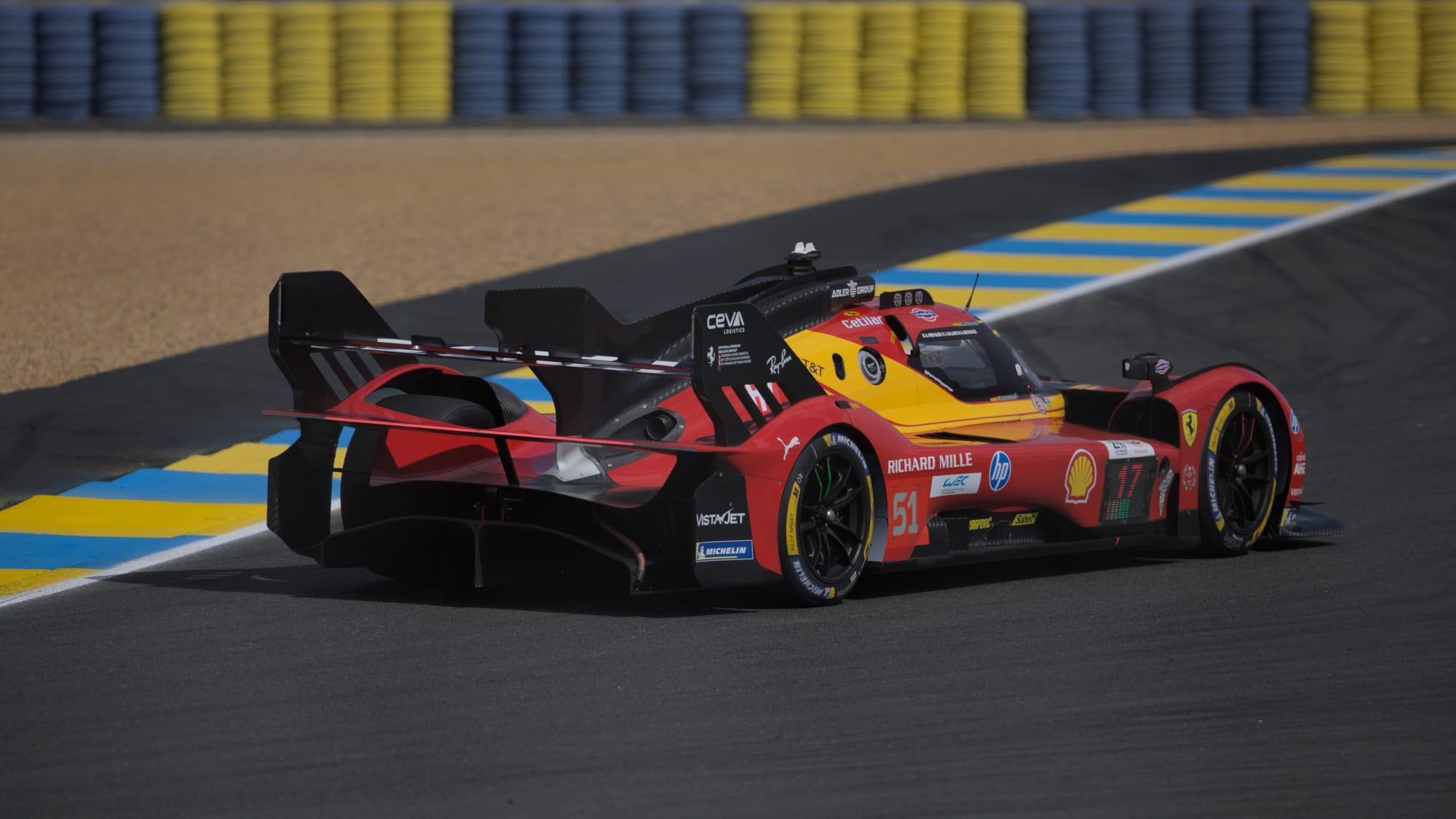
Sébastien Buemi, Brendon Hartley and Ryō Hirakawa won the 2026 drivers' title in the #8 Toyota at Monza on 8 November, and clinched it by finishing a distant tenth. The race itself went to the #38 Cadillac of Jack Aitken, Earl Bamber and Sébastien Bourdais (official report). The #8's sister crew — Mike Conway, Kamui Kobayashi and Nyck de Vries — had won the season's biggest race, yet finished 18 points behind: 115 to 97 in a title fight decided by who finished more races.
Across eight rounds, Hypercar races were won by four manufacturers and five different cars. Nobody dominated. That is 2026's headline finding: at the maturity of the 1,030 kg / ~520 kW Hypercar formula, the field is compressed enough that finishing has become the decisive skill.
The arithmetic of the title (analysis)
The #8 crew won three races — Imola, Fuji and Barcelona — and the title came from what never happened: no retirements. Their worst outings were 10th at Spa, 10th at Monza and a 17th in São Paulo. A third place at Le Mans added 30 points, nearly a conventional win's worth.
The #7 won where it mattered for prestige and lost where it mattered for points. It won at Le Mans, but retired at Austin while leading the standings, and its season was stitched together with 12th in Brazil, 5th at Spa, 8th at Fuji and 2nd at Barcelona. Under a system that pays 25 points for a six-hour win and 50 at Le Mans, one late DNF in a 25-point race is the kind of hole a title is lost in. Kevin Magnussen finished third in the standings on 85 points, splitting the Toyotas' season open in reverse: the BMW was more consistent than the losing Toyota.
Toyota also took the manufacturers' trophy, with BMW second. Same story at constructor level: the titles went to crossing the line rather than making headlines.
Le Mans: BMW's first pole, Toyota's sixth win
The 94th edition's defining moment came before the race started. BMW took its first pole position at Le Mans in the #15 car of Kevin Magnussen, Raffaele Marciello and Dries Vanthoor, after Jack Aitken's provisional fastest Hyperpole lap, quickest by 0.005 seconds, was deleted in the closing minutes (grid report; ACO preview).
The race then played out as an argument for strategy over Saturday pace. The #12 Cadillac of Norman Nato, Will Stevens and Louis Delétraz led much of the night, only to be caught by a Full Course Yellow speed restriction that forced an extra stop and a drive-through penalty. Brendon Hartley passed the Cadillac in the #8 Toyota before a corner-sensor concern slowed it; Kamui Kobayashi then hunted the leaders down in the #7, setting the race's fastest lap, 3:25.041. Robin Frijns briefly led for BMW until a gravel excursion on the pit entry. For the final four hours, roughly 10 seconds separated four cars (race report).
The #7 covered 381 laps to win by 10.913 seconds over the #20 BMW, with the #8 third and the #12 Cadillac fourth. It is Toyota's sixth victory at La Sarthe, its first since 2022, matching Bentley's tally. It was a second Le Mans win for Conway and Kobayashi, and the first Dutch victory in 38 years for de Vries. Ferrari's pursuit of a record fourth consecutive win collapsed when the #50 stopped with electrical failure; Genesis's debut run at Le Mans ended with a suspension failure at Tertre Rouge.
BMW's breakthrough
Five weeks earlier at Spa, the #20 crew of Robin Frijns, René Rast and Sheldon van der Linde converted an audacious short-fuelling call in the opening pit cycle into BMW's first outright victory in the World Endurance Championship, from 10th on the grid. Magnussen held off Ferrari and Toyota in the #15 for a 1-2 that the FIA described as the marque's first outright victory in global endurance racing since Le Mans 1999. São Paulo added a second win for the #15. BMW's season contradicted its 2024-25 learning curve: the M Hybrid V8 is a regular winner now, and its points total shows it.
LMGT3: seven winning cars in eight races
The GT class resisted pattern almost entirely. Team WRT (No. 69, Imola), Garage 59's McLaren (No. 10, Spa), TF Sport's Corvette (No. 33, Le Mans), Racing Team Turkey by TF (No. 34, São Paulo), Heart of Racing's Aston Martin (No. 27, Austin), WRT's BMW (No. 32, Fuji) and The Bend Manthey Racing's Porsche (No. 92, twice: Barcelona and Monza) split the wins.
Jonny Edgar took the championship, a 22-year-old Briton sharing the #33 Corvette with Ben Keating and Nicky Catsburg, on 107 points — four clear of Catsburg and eight ahead of Richard Lietz, Riccardo Pera and Yasser Shahin, who won the final two rounds (official classification). Edgar arrived with an unusual curriculum for a GT champion: the 2020 ADAC Formula 4 title, then the 2024 European Le Mans Series. The #33 also won the LMGT3 class at Le Mans — the class's feel-good result, ahead of a first Le Mans podium for Lexus with Akkodis ASP's #78 — and TF Sport took the teams' trophy.
One footnote for the Hypercar standings: Aston Martin's #007 Valkyrie crossed the line third at Monza and lost its podium to a post-race penalty for a tyre-pressure infringement. On the road, Aston's first full season with the Valkyrie was quiet but included a top-10 Le Mans finish; Genesis took a first pole at Barcelona before reliability defined its season.
Off the track: a reshuffled calendar, a closed rulebook
The Qatar 1812km and the Bahrain 8 Hours came off the calendar because of the regional conflict, replaced by a first-ever 6 Hours of Barcelona and the Monza finale (FIA confirmation; our earlier coverage).
More consequential for how the sport is judged: the FIA and ACO stopped publishing Hypercar Balance of Performance tables for 2026 (motorsport.com). Ferrari endurance boss Olivier Coletta criticised the move openly, saying "with the BoP hidden, part of the race story will be missing". Analysis: when BoP inputs are secret, public scrutiny shifts from documents to outcomes; close results can no longer be interrogated, and questions about who is being helped by the tables become unfalsifiable. That is a credibility cost the series will pay if a controversial title fight ever arises.
2027: nine rounds and a certain McLaren
The FIA has published a nine-round 2027 calendar, the championship's largest in a decade: Qatar returns on 27 March, Le Mans runs 12-13 June, Silverstone returns, and Bahrain closes the season on 6 November (FIA news). McLaren confirmed its Hypercar entry for 2027 and completed the driver line-up around Malthe Jakobsen (ACO news) — a move with direct consequences for the Triple Crown conversation we ran earlier this year.
The verdict on 2026, for anyone deciding what to watch next year: the Hypercar grid now has at least four manufacturers that can win on their day, in a points system that pays for finishing. In the BoP era, that is as close as endurance racing has come to what its rulebook promises.
Discussion